
People have always judged businesses by what they can see.
A strong product matters, but before someone has used it, tested it or learned to trust it, they rely on signals. They judge the name, design, presentation, language, confidence, people and overall feeling surrounding it.
That perception can be shaped.
In January 1977, Mike Markkula wrote an early marketing philosophy for the young Apple business. It was built around just three principles:
Empathy. Focus. Impute.
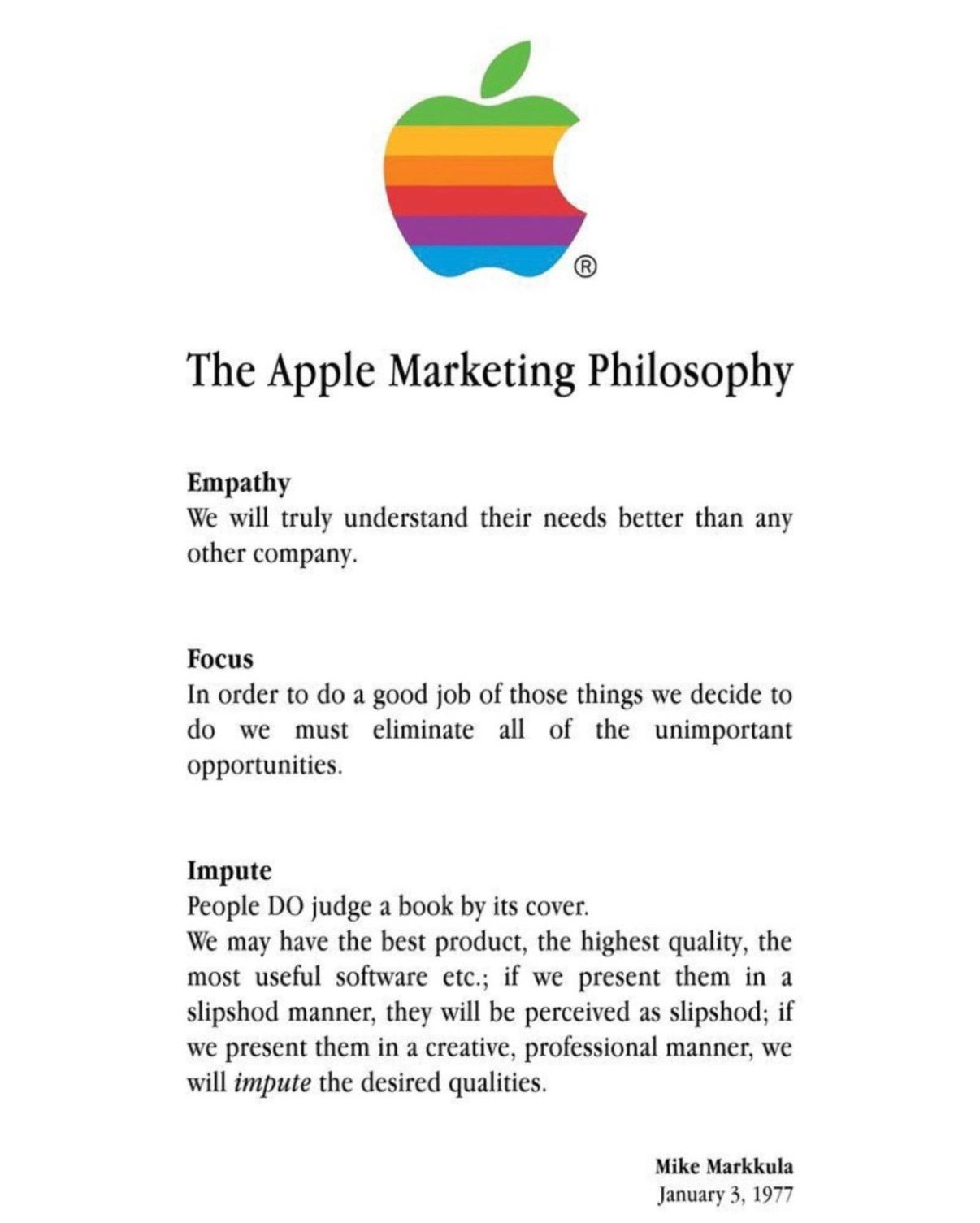
Markkula was an early Apple investor and senior influence on the company. His document helped establish an approach that brought customer understanding, business discipline and presentation together from the start.
Nearly 50 years later, those principles still offer a useful way to think about brand and marketing.
Empathy: understand people properly
Apple’s first principle was to understand customers’ needs better than anyone else.
That sounds obvious, but many businesses begin from the opposite direction. They focus on what they’ve made, what they want to sell and what they need the market to understand.
Empathy starts with the person on the other side.
What are they trying to achieve? What frustrates them? What feels unnecessarily difficult? What would make the product feel useful rather than merely technically impressive?
Jobs was famously sceptical of asking customers to describe the next product, but that wasn’t the same as ignoring people. Apple’s approach was to interpret human needs beyond the most literal product request.
Focus: remove what doesn’t matter
The second principle was focus.
To do a good job on the things Apple chose to pursue, Markkula argued that the business had to eliminate unimportant opportunities.
That’s harder than it sounds.
Businesses often confuse growth with addition. More services, more messages, more audiences and more features can feel like progress. In reality, they can make the proposition harder to understand and the organisation harder to run.
Focus creates confidence. It tells employees where effort should go and helps customers understand what the business wants to be known for.
Impute: presentation shapes perception
The third principle is perhaps the most interesting.
Markkula recognised that people do judge a book by its cover. Even a brilliant product could be perceived as careless if it was presented carelessly. Creative and professional presentation could help people recognise the quality within it.
That isn’t superficial. It’s how people make decisions when they don’t yet have complete information.
A prospective customer can’t inspect every internal process before buying. They look for evidence. Design, language, packaging, service and behaviour become signals of what they’re likely to experience.
Done well, those signals create confidence. Confidence helps build trust. Trust makes demand more likely.
That’s why brand-building isn’t decoration. It’s part of the commercial infrastructure around the product.
Apple’s philosophy didn’t begin with advertising channels or sales tactics. It began with people, choices and perception.
That remains a useful place for almost any business to start.